Farmland in Vinukonda: What Buyers Should Check Before Buying
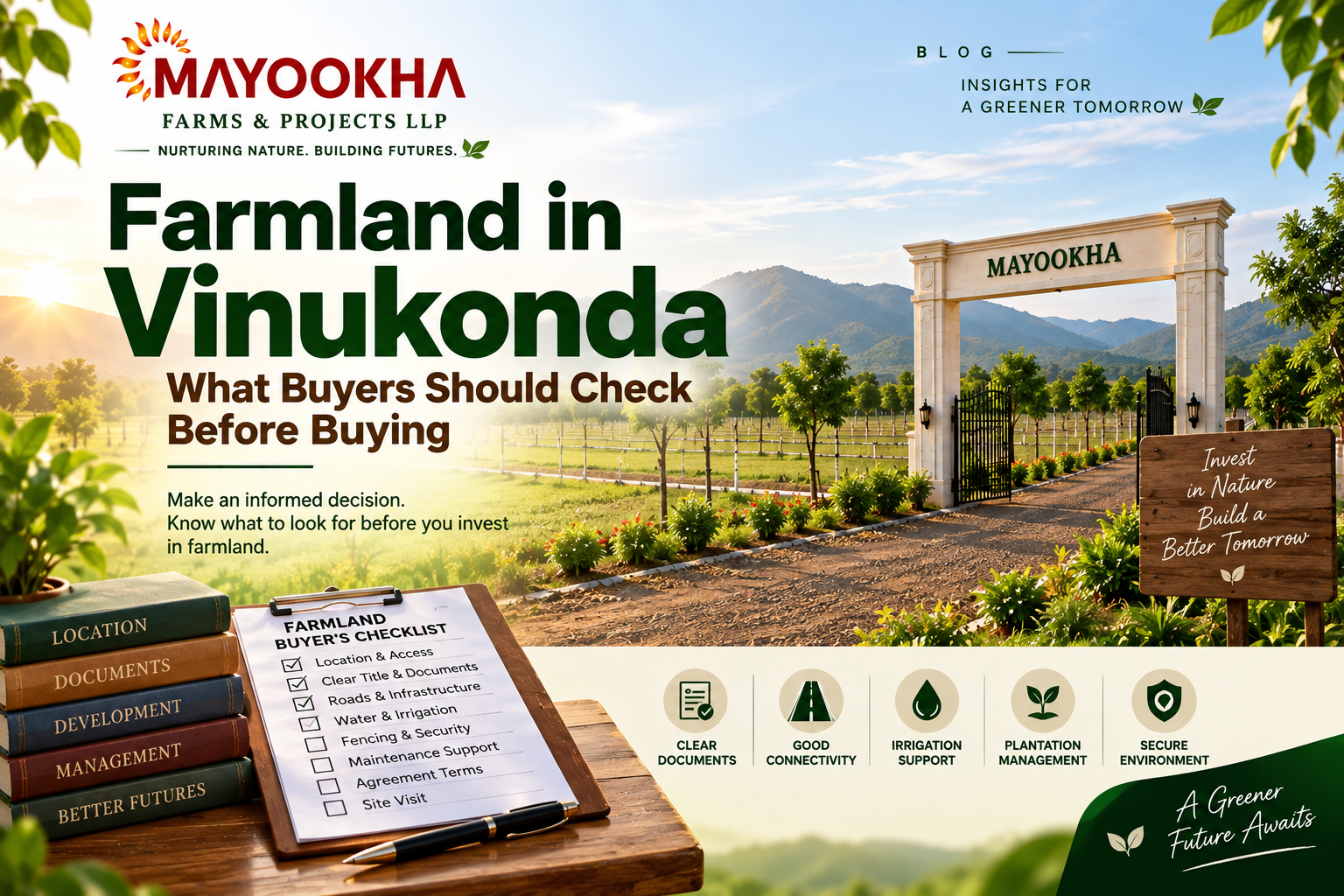
Finding farmland at an attractive price can be exciting. But once you move beyond the brochure and start looking at the actual land, several practical questions come up.
Is the title clear? How is the land accessed? What roads are available? Who handles maintenance? Is irrigation available? What exactly is included in the project? And perhaps most importantly, do the documents and agreement match what has been promised?
These are the questions worth answering before buying farmland in Vinukonda.
Vinukonda, in Andhra Pradesh, has become an area of interest for people looking at agricultural land and managed farmland projects. For a buyer, though, the location alone should not be the deciding factor. The land, documentation, development, facilities and management arrangement all deserve a closer look.
Why consider farmland in Vinukonda?
Vinukonda offers a combination of agricultural surroundings and connectivity to nearby urban and regional locations.
For someone considering farmland, this can make the area worth exploring. But buying land is different from simply visiting a location and liking what you see.
A buyer should look beyond the general development around an area and evaluate the particular property being offered.
Things such as access roads, documentation, layout, water arrangements, fencing, maintenance and registration terms can make a significant practical difference.
That is why a site visit should be part of the decision-making process.
What should you check before buying farmland?
There is no single factor that determines whether a farmland project is suitable. A better approach is to look at several aspects together.
1. Start with the land documents
Documentation should come before excitement about the location or future possibilities.
Ask to see the relevant land records and understand who owns the property, how the land is being transferred and what documentation will be provided to the buyer.
If the project involves plotted farmland, understand the exact plot being purchased and how it is identified in the layout.
Do not rely only on verbal explanations. Important terms should be reflected in the documents and agreements.
2. Understand the registration process
A buyer should know exactly how the property will be registered.
Ask:
Who will be the parties to the registration?
What documents will be provided?
When does registration take place?
What is included in the agreed price?
Are there any separate charges that the buyer should know about?
Clear answers to these questions can prevent confusion later.
Mayookha Farms & Projects says its farmland model includes support from the initial site visit through plot selection, registration, plantation progress and documentation. �
Mayookha Projects
3. Visit the actual site
Photographs can give you an idea of a project. They cannot replace a site visit.
When visiting farmland in Vinukonda, look at the actual approach road, surrounding development, plot boundaries, internal roads and general condition of the property.
Walk through the plot if possible.
Look at the surroundings rather than concentrating only on the entrance or model areas.
A site visit also gives you an opportunity to ask questions directly and compare what you see with what was communicated to you.
Roads and accessibility matter
Farmland does not need to look like a city residential layout, but reasonable access is still important.
Check the road leading to the project and the internal road network.
For example, the current Mayookha Vinukonda Farmlands project specifications include a 30-foot main road, along with 20-foot and 16-foot internal roads.
The project information also places the farmland approximately 4 km from the Srisailam Highway and around 12 km from Vinukonda municipality.
These details are useful, but a buyer should still verify the actual route and accessibility during a site visit.
What about water and irrigation?
Agricultural land and plantations need a practical water-management plan.
If a project includes plantation development, ask how the plants will be watered and who will be responsible for maintaining the system.
The current Mayookha Vinukonda project includes a drip irrigation system for the red sandalwood plantation.
Mayookha also describes drip irrigation as part of its broader farmland development approach, with systems designed to deliver water closer to plant root zones. �
Mayookha Projects
Irrigation, of course, is only one part of plantation management. Soil conditions, plant health, maintenance and other factors also need to be considered.
Fencing and security are worth checking
A farmland project may be spread across a large area, so boundary protection and monitoring can be practical considerations.
The current Vinukonda project specifications include diamond wire fencing, 24/7 CCTV surveillance and monitoring, and a grand entrance main gate.
During a site visit, buyers can check the actual fencing and security arrangements rather than relying entirely on photographs.
The question is simple: what is already present, what is planned, and what does the agreement say?
Who maintains the farmland?
This is one of the questions that can easily be overlooked.
Owning farmland does not necessarily mean that the owner personally needs to handle every plantation and maintenance activity. In a managed farmland model, some responsibilities can be handled by the project developer according to the agreed terms.
Mayookha Farms & Projects describes its approach as combining land development, agroforestry and ongoing management. Its website also describes support for plantation and farmland management after development. �
Mayookha Projects
However, buyers should still read the specific project agreement carefully.
Do not assume that every service shown in general company information automatically applies to every project.
The project-specific terms are what matter.
What does the Mayookha Vinukonda farmland project offer?
The current Mayookha Vinukonda Farmlands project is positioned as a managed farmland development with red sandalwood plantation and supporting infrastructure.
The available plot sizes and current prices provided by Mayookha are:
5 Guntas
605 sq. yards | 12.5 cents | ₹5,00,000
10 Guntas
1,210 sq. yards | 25 cents | 1/4 acre | ₹9,00,000
20 Guntas
2,420 sq. yards | 50 cents | 1/2 acre | ₹18,00,000
40 Guntas
4,840 sq. yards | 100 cents | 1 acre | ₹36,00,000
The project also includes a 60:40 red sandalwood profit-sharing arrangement, with 60% allocated to the customer and 40% to the company, according to the current project terms provided by Mayookha.
Anyone considering the project should review the actual agreement to understand the conditions, calculation method and responsibilities associated with this arrangement.
What infrastructure should you look for?
The land itself is important, but supporting infrastructure can affect the practical experience of owning managed farmland.
The current Vinukonda project specifications include:
Portable iron cabin as a site farmhouse
30-foot main road
20-foot and 16-foot internal roads
Diamond wire fencing
Grand entrance main gate
Cement plot number name boards
CCTV surveillance and monitoring
Red sandalwood plantation with drip irrigation
These features should be evaluated as part of the complete project rather than individually.
For example, a road is useful because it provides access to the plots. Fencing provides a defined boundary. Irrigation supports plantation management. Plot numbering helps identify individual plots.
The value is in how these elements work together.
Understand what you are actually buying
This sounds obvious, but it is one of the most important questions to ask.
Is the buyer purchasing a specific parcel of land? What is the plot size? How is the plot identified? What rights and responsibilities come with the purchase?
If there is a plantation arrangement attached to the land, understand how that arrangement works separately from the land ownership.
If there is a lease agreement, profit-sharing arrangement or maintenance commitment, read the relevant terms rather than relying on a verbal explanation.
A clear understanding at the beginning makes the ownership experience much easier.
Do not make the decision only because of future development
Vinukonda's surrounding region has wider infrastructure and development activity, and connectivity to larger regional centres can be an additional consideration for farmland buyers.
Amaravati, for example, is an important part of Andhra Pradesh's wider development landscape.
But there is a distinction worth keeping in mind.
Vinukonda is Vinukonda. It is not Amaravati.
A property should first make sense based on its actual location, access, documentation and project characteristics.
Potential future development can be considered as a surrounding factor, but it should not be treated as a guarantee of land appreciation.
The same principle applies to any claim about future returns.
Is managed farmland different from vacant agricultural land?
Yes, in terms of the responsibilities involved.
With vacant agricultural land, the owner may need to arrange development, plantation, irrigation, fencing and ongoing maintenance independently.
A managed farmland project can bring some of these activities together under a coordinated arrangement.
Mayookha's farmland model describes a process that covers land selection, development, plantation and ongoing management. �
Mayookha Projects
That approach may be particularly relevant to buyers who want farmland ownership but may not be able to visit and manage the property regularly.
Still, the exact services and responsibilities should always be confirmed in the project documentation.
Questions to ask before buying farmland in Vinukonda
Before making a decision, take a written list of questions with you when visiting the project.
Ask:
Who owns the land and what documents will I receive?
What exactly is the registration process?
What is the exact size and location of my plot?
What roads provide access to the project and individual plots?
What irrigation facilities are included?
Who is responsible for plantation maintenance?
What happens if plantation activities require additional work?
What security arrangements are available?
Are the facilities already completed or planned?
What does the agreement say about maintenance and plantation management?
If there is profit sharing, how exactly is it calculated?
What are the applicable terms relating to the red sandalwood plantation?
These questions are more useful than simply asking whether the land is a "good investment."
A site visit can tell you a lot
For anyone searching for farmland for sale in Vinukonda, the next step should ideally be more than a phone call.
Visit the property.
Look at the roads.
Check the surroundings.
Understand the plot layout.
Ask to see the relevant documents.
Discuss the plantation and maintenance arrangements.
And take your time before signing anything.
A good farmland decision does not need to be rushed.
Why Mayookha focuses on managed farmland
Mayookha Farms & Projects combines farmland development with agroforestry and ongoing management.
The company's current farmland information describes a process that covers land selection, development, plantation and management. It also highlights planned infrastructure and support throughout different stages of farmland development.
Mayookha Projects
For the Vinukonda project, the combination of farmland, red sandalwood plantation, irrigation, roads, fencing, monitoring and other site facilities provides buyers with more than an undeveloped piece of agricultural land.
But the right question is not simply whether a project has many features.
The better question is whether those features, the land documents and the project agreement fit what you actually want from the property.
The bottom line for buyers
Buying farmland in Vinukonda should begin with due diligence, not just the price per square yard.
Look at the land.
Check the documents.
Understand the registration process.
Visit the site.
Examine the infrastructure.
Ask about water and plantation management.
Read the agreement carefully.
And understand any regulatory or contractual conditions connected with the plantation.
Mayookha's Vinukonda Farmlands project offers different plot sizes along with red sandalwood plantation and supporting infrastructure. For someone considering the project, understanding exactly what is being purchased and how the property will be managed is more useful than relying on a simple promise of future appreciation.
In the end, a farmland purchase should make sense on its own terms.
That is the strongest place to start.
Frequently Asked Questions
Is farmland in Vinukonda suitable for long-term ownership?
It can be considered by buyers who are comfortable with agricultural land ownership and the longer-term nature of farmland and plantation management. Individual suitability depends on the buyer's circumstances and the specific project terms.
What should I check before buying agricultural land in Vinukonda?
Check the land documents, ownership, registration process, plot identification, road access, irrigation, fencing, maintenance arrangements and the terms of any project agreement.
What plot sizes are available in the Mayookha Vinukonda project?
The current project information provides 5-gunta, 10-gunta, 20-gunta and 40-gunta options, corresponding to 605, 1,210, 2,420 and 4,840 square yards respectively.
Does Mayookha's Vinukonda project include plantation?
Yes. Red sandalwood plantation is part of the current project, along with a drip irrigation system and other supporting infrastructure.
Does the project provide roads and fencing?
The current project specifications include a 30-foot main road, 20-foot and 16-foot internal roads, and diamond wire fencing around the venture.
Why should I visit farmland before buying?
A site visit allows you to assess the actual location, approach roads, surroundings, plot layout and project facilities. It also gives you an opportunity to ask questions and compare the site with the information provided.
Should I rely on future land appreciation when making a decision?
No. Future appreciation is not guaranteed. A buyer should first evaluate the land, documentation, location, infrastructure, management arrangements and personal suitability before considering possible future value.